Wednesday, 3 May 2017

Racing Heroes – Niki Lauda

On August 1, 1976, while driving for Scuderia Ferrari in the German Grand Prix, Niki Lauda’s Ferrari 312T2 exited the Nuerburgring circuit just before the Bergwerk corner, perhaps due to a rear suspension component failure. After striking an embankment, Lauda’s Ferrari unblocked games mills eagles, already on fire, returned to the racing surface where it was struck by a Surtees-Ford driven by Brett Lunger. In a surprising feat of heroism, a corner marshal and four drivers who climbed from their cars (including Lunger, Harald Ertl, Arturo Merzario and Guy Edwards) pulled Lauda from the flaming wreckage. They were successful, but not before Lauda suffered life-threatening burns to his lungs and face.

Though Lauda was reportedly conscious following the crash, his injuries were so extensive that the driver quickly lapsed into a coma. At the hospital, a priest was called to administer last rites, and few believed that the damage to Lauda’s lungs (caused by the inhalation of hot, toxic gases) would be repairable. If the Austrian driver did manage to survive these injuries, he still had second- and third-degree burns and the ever-present risk of infection to contend with. By the most optimistic of projections, Lauda was facing many months of recovery, assuming he survived at all.

Forty-three days later, defying all odds, Lauda climbed back behind the wheel of a Ferrari 312T2 at the Italian Grand Prix. Accounts of the day stated that blood was still weeping from bandages on his head, and that reconstructive surgeries to rebuild his right ear and right eyelid were still pending. Despite this, Lauda qualified fifth on the grid (two positions above his “replacement” at Ferrari, Carlos Reutemann, and four positions above his teammate, Clay Regazzoni) unblocked games happy wheels and ended the race in fourth position.

Perhaps more than Lauda’s 25 Formula 1 victories and three series championships, his recovery from near-fatal injuries during the 1976 season paints the picture of Niki Lauda the man and Niki Lauda the driver. Supremely talented and even more headstrong, Lauda always seemed to be struggling with something throughout his career, perhaps shaping his will to compete and his drive to win.


Behind the wheel of a Formula Vee, 1969. Photo courtesy Volkswagen Motorsports.

Born into a wealthy Austrian family in February of 1949, Lauda’s decision to begin racing cars was frowned upon, particularly by his grandfather. Progressing through the ranks from racing sedans to racing Formula Vees to racing sports cars, Lauda uncovered an opportunity to join the March Formula 2 team in 1971. There was, however, a catch: To get a seat, Lauda would need to bring sponsorship money with him, and a deal was quickly cut with an Austrian bank. Lauda’s grandfather soon opposed the deal, prompting the bank to withdraw its funding for Lauda’s blossoming career. In a supreme act of defiance, Lauda approached a second bank, taking a loan against his life insurance policy to produce the funding required to join the team.

By 1972, Lauda was driving for March in both Formula 2 and Formula 1, but only the team’s Formula 2 squad proved competitive. To advance his career, Lauda realized that a change in teams would be necessary, so he once again sought a bank loan to buy his way onto the BRM Formula 1 team. Though Lauda’s fortunes improved at BRM in 1973, where he scored two championship points compared to none with March in 1972, his fortunes changed when BRM teammate Clay Regazzoni re-upped with Ferrari for the 1974 season. Regazzoni spoke highly of Lauda, prompting the team to invite Lauda to Maranello.

As Lauda recently recounted to Top Gear, Enzo Ferrari himself extended an offer for Lauda to drive with Scuderia Ferrari, telling Lauda “you are an unknown and nobody knows why you are so fast.” Hardly negotiating from a position of strength, Lauda accepted an offer that amounted to the modern equivalent of roughly $66,000 per season, and his first race with Ferrari was the 1974 season-opening Argentine Grand Prix. Lauda would finish fourth in the standings that season behind Regazzoni, Jody Scheckter, and Emerson Fittipaldi, but his six consecutive pole positions would speak of things to come in 1975.

Though the year began with underwhelming results in Argentina, Brazil and South Africa, Lauda captured his first pole of the year in Spain. A collision at the start of the race ended Lauda’s day before the first corner, but his fortunes would change dramatically in Monaco, where Lauda would kick off a three-race winning streak. In the seven races that followed, Lauda scored two more victories and an additional three podium finishes, easily capturing his first F1 championship.


Lauda practicing for the fateful 1976 German Grand Prix. Photo courtesy Lothar Spurzem.

In the races leading up to Lauda’s 1976 crash at the Nürburgring, the Ferrari driver appeared poised to capture his second championship. The aftermath of the accident would also see the initial souring of Lauda’s relationship with Ferrari; literally giving him up for dead, Ferrari recruited Reutemann to replace Lauda for the remainder of the season. When Lauda announced his return to the cockpit at Monza, the team initially seemed indifferent about giving him a car to drive. Things would go from bad to worse at the season-ending Japanese Grand Prix: Still in contention for the championship, Lauda parked his Ferarri when the FIA failed to red-flag the race, held in a torrential downpour. Lauda’s safety protest handed the 1976 championship to James Hunt, prompting many fans to call for Lauda’s dismissal; some even went so far as to call Lauda a coward, despite the fact that the Austrian driver was back in the cockpit, as fast as ever, just six weeks after suffering his horrific crash.

The following season, 1977, dawned with Lauda being told he’d be second in the pecking order to Reutemann. At pre-season testing, Lauda was instructed to test brake pads while Reutemann tested tires, at least until Lauda threatened to walk away from his contract and join the McLaren F1 team. When the team relented, Lauda showed his merit by turning a quicker time in three laps than Reutemann had turned in a week of testing. Still, the writing was on the wall, and after clinching his second championship at the Italian Grand Prix, Lauda walked away from the team to sit out the season’s two remaining races.

Lauda would race for the Brabham Alfa-Romeo team in 1978 and 1979, but would finish fourth in the points the first year and 14th the following year. Frustrated with the team’s results, Lauda retired from F1 before the end of the 1979 season, preferring to spend his time running charter airline Lauda Air. His departure from the sport would be short-lived, however, as 1982 saw him return to the cockpit for McLaren. He’d drive for the team an additional three seasons, capturing his third world championship (by a mere half a point over Alain Prost) in 1984.

It’s all but impossible to recount Lauda’s successes, both on and off the track, in a single, brief article. In business, as well as in racing, Lauda is widely regarded as a man unafraid to tackle a new challenge, regardless of how daunting it may seem, and utterly uncompromising on his principles. Still active in motorsports, today Lauda serves as the non-executive chairman of the Mercedes AMG Petronas F1 Team’s board of directors, which may help account for the team’s remarkable progress during the 2013 season. Regardless of later achievements, Lauda will always be best remembered for his almost superhuman recovery and return to the highest levels of motor racing during the 1976 season.

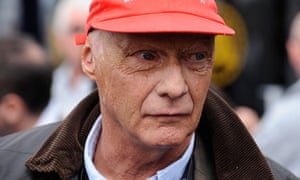
Saturday, 4 June 2016

Niki Lauda accused of homophobia after attacking TV dancing show

Motor racing legend objects to gay men competing together on prime time programme


Niki Lauda demanded a halt to 'a gay show on state television'. Photograph: Tom Jenkins for the Guardian

Austrian gay groups have demanded an apology from the former racing driver Niki Lauda after he made disparaging remarks about the pairing of a gay male celebrity with a male dancer on Austria's version of Strictly Come Dancing.

Alfons Haider, a 53-year-old TV presenter from Vienna, is set to waltz with another man in the forthcoming series of Dancing Stars on the state-owned ORF channel.

Lauda, the three-times world Formula One champion, told the Austrian daily newspaper Österreich he didn't want to have to explain to his children why two men were dancing together on prime time TV.

"There are some good traditions in our culture, one of which is that men dance with women," he said. "Soon we will reach the stage where we will all have to publicly apologise for being heterosexual."

Lauda, 61, said he was upset "that I have to explain to my children why men no longer dance with women on TV, as is traditional".

The German tabloid Bild asked Lauda if it was really so bad for two men to dance together. "No," said Lauda. "As long as they do it at home and not on TV, when children are watching."

He insisted he was not homophobic and that he would not mind at all if his son was gay. He employed "loads" of gay people on his airline, Niki, "even as instructors", he added.

Christian Högl, the chairman of the Vienna-based gay rights group Hosi, said: "We are really shocked and very surprised that Mr Lauda harbours such prejudice against homosexuals to make such an unjustified attack."

The group has invited Lauda to the city's Rainbow Ball next month in a bid to educate him about homosexuality.

Dancing Stars is not due to start until March, but Lauda wants ORF bosses to pull the plug on the gay pairing.

"I demand that the general director Alex Wrabetz, who is in an upright marriage, stops this gay dance number – and that the PR-crazy Alfons Haider is not permitted to put on a gay show on state owned television," Lauda told Österreich.

Wrabetz said : "I don't chose Mr Lauda's pilots and he doesn't choose our dancers."

Top Gear chats to Niki Lauda

There are many great moments in Rush, but although the film is a cocktail of fast racing, faster women, old-school male bravado and general chicanery, Niki Lauda’s fiery crash during the 1976 German Grand Prix puts it all into brutal perspective. It’s the section that anchors the film, the one that elicits audible gasps among the audience before plunging them into a contemplative silence.

And no wonder. Ron Howard handles the aftermath with elegance and sensitivity, but he doesn’t hold back on the unimaginable pain Lauda endured as he defied the priest who read him the last rites and the doctors who doubted he’d ever recover. This is a man who had his lungs vacuum pumped repeatedly, and had a nurse peel off his bandages under neon lighting while his wounds were at their worst. They were still raw when he climbed back into his car at the 1976 Italian GP 43 days after his crash, to finish fourth in front of a stunned tifosi and bemused paddock.

All this stuff ricochets around your head when you meet Lauda for the first time. It doesn’t much diminish the second time. In fact, it’s difficult not to be cowed in his presence no matter how often you meet him. He’s that guy. Formula One’s ultimate survivor. The driver who won two world championships for Ferrari, quit the sport to set up a successful commercial airline, then returned to win a third title in 1984 driving for McLaren. It’s also well known that this scion of an Austrian banking dynasty doesn’t suffer fools gladly. I know this because I was the fool who asked him a stupid question back in 2001 when he was running the ill-fated Jaguar F1 team, and got a blast of the Lauda hair-drier for my trouble.

Perhaps age has mellowed him. He married again a few years ago, and his wife Birgit gave birth to twins, Max and Mia. Talking about fatherhood makes his eyes sparkle, and he concedes that he was simply too selfish to be much good at parenting the first time round (he has two sons, Matthias and Lukas, from his first marriage, and another son, Christoph, from another relationship). I met him in Vienna last year, on Ferrari-related business, then again at Monaco earlier this year. On that occasion, the more mellow Lauda was nowhere to be seen: news of the Mercedes F1 team’s opportunistic Pirelli tyre test had just broken in the paddock and watching him - these days non-executive chairman of the Merc F1 team, remember - was like watching hell bubbling up before your very eyes.
The logic-driven, apparently unemotional young Lauda is brilliantly captured by the German actor Daniel Brühl in Rush. The more seasoned Niki insists he wasn’t quite as serious as he comes across in the film. Based on the meetings across a decade, I’d be inclined to agree. It’s better than arguing with him…

Top Gear: Are you as cool and calculating as you appear in Rush?
Niki Lauda: I am emotional. But I also have everything well under control and I can analyse things properly. What drives me crazy is the amount of talking that goes on. I like to make my life simple. I get straight to the point. If it’s my mistake, it’s my mistake. In motor racing, you learn to achieve the best result in the shortest amount of time. It applies in life too. Be quicker than the others. And don’t make mistakes. Even if things fail, have the discipline to find a new way, rather than embarking on a pointless emotional journey.

TG: Your family wasn’t happy when you decided to become a racing driver.
Niki Lauda: My biggest problem was my grandfather. He was president of the Red Cross and ran a huge company in Austria. I had a good relationship with my mother and father, but my grandfather… I fought my grandfather like you wouldn’t believe. I went my own way, and decided to become a racing driver. I don’t think I would ever have fought that hard if my grandfather had been a reasonable person.

TG: So you had to pay your way into your first drive.
NL: I joined March with Max Mosley at the time. I was an unknown driver who could bring money to help their budget. I had sponsorship from an Austrian bank. It went to the supervisory board, and my stupid grandfather stopped it from happening! So I went to another bank, and he said, ‘what happens if you die?’ So I secured the loan against my life insurance. I put their logo on my helmet, which is how I got out of the mess my grandfather put me in.

TG: Did your grandfather ever say, “sorry Niki, you did well…”
NL: No. I broke with him, and the poor guy died before we had a chance to make peace.

TG: You raced for BRM, run by Louis Stanley, when it was a fading force. But it was still enough to get you noticed by the most famous team of all.
NL: ‘If Ferrari calls, don’t forget to tell me’. It was a running joke. I would always say this as I left my little office in Salzburg. I got back on Tuesday, and my secretary said, “Ferrari called”. “Don’t joke,” I replied. “No really, someone called Monteprezelo or something…” I called him, I went to Maranello, I saw the Old Man and he said, “I want you to drive for me”. Why? “Because you are ahead of Ickx and you are an unknown and nobody knows why you are so fast…” I told him I’d just had dinner with Mr Stanley. The Old Man said, “I’ll fix it”. Then we got to Brands Hatch and there was a rumour that the British police weren’t going to allow the Ferrari transporter through because of a dispute between BRM and Ferrari over the driver Niki Lauda! This was the rumour in the paddock. Actually, it was Bernie [Ecclestone] who helped sort that.

TG: How was it meeting Il Commendatore the first time?
NL: It was quite simple negotiating with him because I didn’t have very much to negotiate about. I think he paid the equivalent of 50,000 euros today. I said, “at least let me have a car”, and they sold me one - at a discount. A cheap car but not free, not part of the deal. Then I came over to do my first test. The 1974 car was very uncompetitive, remember. At Fiorano TAG Heuer had installed the photocell timing equipment, which was very clever, and I thought, ‘they have this technology, and yet they can’t make a competitive car, I don’t understand the world any more’. I told Piero [Ferrari], “the car is s***, it understeers everywhere…” He replied, “you can’t say that, it’s a Ferrari!” “Tell the Old Man I think the car is no good”, I said. It doesn’t turn in properly, and there is no balance. Then Forghieri [Mauro, Ferrari’s famous technical director] was brought back from Siberia. We decided we could go half a second faster. Piero said, “that’s very brave. If you say this, you have to make it happen.” Forghieri fixed the geometry, and I went 8/10ths of a second quicker. And for whatever reason, the Old Man trusted me from that moment on.

TG: You’d passed some sort of test. Or perhaps simply proved yourself.
NL: Ferrari’s interest was only to win. He didn’t really care about the drivers. He liked Villeneuve because he was crazy. And he liked me because I told him the truth, and didn’t bulls*** him. He was friendly with me, accepted me. I would simply knock on his door. Looking back now, after all the fights I had with him after my accident, he was a very egocentric man. Absolutely focused on his cars, on his ideas, being successful in a brutal way. But in the end, he was Italian and he had a heart. I had the opportunity to experience it on the odd occasion, but the rest of the time it was not funny. Let me tell you this. Audetto [then team manager] visited me in hospital, after my accident, and went back to the paddock, went up to Fittipaldi and said, “Lauda is dead, we want to offer you a two-year contract”. Emerson rang me when I was better, and said, “nobody knew if you were dead or alive and they were already talking to me about a contract! Replacing you for a few races, that I would understand…” And this was not Audetto. This was an order from Ferrari himself. But listen, in terms of charisma and personality, none of today’s Formula One managers can compare with Enzo. Think how long he has been dead, and we’re still talking about him!

Niki Lauda Austrian race-car driver

Niki Lauda, byname of Andreas Nikolaus Lauda (born February 22, 1949, Vienna, Austria) Austrian race-car driver who won three Formula One (F1) Grand Prix world championships (1975, 1977, and 1984), the last two of which came after his remarkable comeback from a horrific crash in 1976 that had left him severely burned and near death.

Lauda was born into a wealthy paper-manufacturing family that disapproved of his interest in racing. Undaunted, he began racing Minis in 1968, moving on to Formula Vee and Formula Three thereafter. In 1971 he secured a loan against his life insurance policy to buy his way into the March Engineering Formula Two team. While still primarily a Formula Two driver, Lauda participated in his first F1 race during his initial season with March, and in 1972 he raced in 12 F1 events.

Lauda raced in the 1973 F1 season as a member of the British Racing Motors team. In 1974 he signed with the prestigious Scuderia Ferrari team and garnered his first career F1 victory (as well as an additional win), finishing the season in fourth place. He broke out in 1975, winning five races to capture his first world championship.

The 1976 racing season is one of the most storied in F1 history. Through nine races, Lauda had five victories and more than twice as many points in the championship standings as his closest competitor. Lauda tried to get the other drivers to agree to a boycott of the 10th race of the season, the German Grand Prix at the Nürburgring, because of safety concerns about racing through the Eifel Mountains, but he was outvoted. In the race’s second lap, Lauda lost control of his car and slammed into an embankment. The car burst into flames, and Lauda was pulled from the wreckage, having inhaled noxious gasses. He sustained burns that cost him his eyelids, half of an ear, and large portions of his scalp. He later lapsed into a coma and was administered last rites by a priest, but he recovered and returned to racing after missing just two events. Britain’s James Hunt had won the German Grand Prix, as well as one more contest in Lauda’s absence, and he and Lauda entered into an electrifying chase for the 1976 title. Hunt was three points behind Lauda heading into the final event, the Japanese Grand Prix. Heavy rains on the day of the race led Lauda to withdraw because of safety concerns, and Hunt finished in third place to capture the championship by one point.

Lauda won three races and finished in second place six times in 1977 to win another world championship. However, his relationship with Ferrari was strained by his decision to withdraw from the previous season’s final race and—having already clinched the title—he, in protest of his treatment, stopped racing for the team with two events left in 1977. He joined the Brabham team for the 1978 F1 season, but, after winning just two races over two years because of the inferior cars he was given, he retired from racing in September 1979 to focus on Lauda Air, the airline that he had founded earlier in the year. Lauda was lured back into racing in 1982 when he was offered what was then the most lucrative driver contract in F1 history from the McLaren team. After finishing 1982 and 1983 in 5th and 10th place, respectively, he tallied five wins in 1984 to win his third career world championship by a half-point margin. He retired from the sport for good after a 10th-place finish in 1985. After his retirement, he served in various executive capacities for a number of racing teams, was a television racing analyst, and founded another airline, NIKI (he later sold his stakes in both airlines).

The rivalry between Lauda and Hunt during the 1976 F1 season was the basis of Ron Howard’s film Rush (2013). Lauda was inducted into the International Motorsports Hall of Fame in 1993.

Niki Lauda Biography

Niki Lauda was a champion Formula 1 race car driver known for his long-standing rivalry with fellow driver James Hunt

Synopsis

Niki Lauda was born into a wealthy Austrian family in 1949. Always interested in cars, Lauda began racing in his early 20s, joining Ferrari in 1974. He took his first world championship a year later, but his career took a nasty turn in August 1976 when he was involved in a terrible crash. Lauda returned to the driver's seat just six weeks later, and he reclaimed the championship in 1977. After initially retiring in 1979 to run an airline he had founded, Lauda returned to racing in 1982, taking the championship for the last time in 1984. He has since served as an adviser to Ferrari and as a television commentator, in addition to running his airline, Lauda Air.

Early Years

Famed race car driver Niki Lauda was born Andreas Nikolaus Lauda on February 22, 1949, into a wealthy Vienna family, but he nevertheless had to earn his way into the world of Formula 1 racing. He became interested in auto racing at a young age through a general love of automobiles, getting his fix parking relatives' cars and thrashing around the Austrian countryside in a 1949 Volkswagen Beetle convertible. Lauda's first race came along in 1968, but, despite his early success (he came in second in that race), his family was fully against the idea of him becoming a race car driver.
Lauda worked his way through the Formula 3 and 2 circuits, supporting his struggling career through bank loans, before landing a spot on the Ferrari Formula 1 team in 1974. Ferrari was a company with a stellar reputation, but one that had not had a racing champion since 1964. Lauda turned that around in his second year as he compiled enough wins to take the championship with a wide margin over second place.

The Rivalry and the Accident

In 1975, Niki Lauda came head-to-head with James Hunt, the flamboyant British driver, for the first time at the Dutch Grand Prix. Hunt took the race, but more importantly Lauda took the championship that year, and the two began a career-long rivalry/friendship. The two drivers would meet again and again over the years, but a key race in 1976 would be different.
During the German Grand Prix, Lauda crashed, with his car bursting into flames. Suffering broken bones immediately, Lauda was unable to escape quickly, and he damaged his lungs and received burns on his head and wrists. Hunt won the race, and Lauda later slipped into a coma, hinting at retirement once he recovered. Hunt, meanwhile, went on to win five more races, suddenly becoming the favorite to win the championship.
Six weeks after his crash, however, Lauda returned to the sport, and he and Hunt met in Japan in the final race of the 1976 season. The roads were wet with rain, and Lauda, perhaps a bit gun-shy, quit after a few laps, citing dangerous conditions. Hunt went on to take third, garnering enough points to become the new world champion.
In 1977, Lauda joined Brabham and retook the championship (despite only winning three races), but at the 1979 Canadian Grand Prix, he suddenly decided to retire from Formula 1 racing to start his own airline.

Later Years

Lauda returned to racing in 1982, possibly enticed by a $5 million offer to race for McLaren. He finished fourth in his first race back, but he went on to win his third championship in 1984. After claiming his final win in 1985, he retired for good at the end of the season.
Off the track, Lauda focused on managing his airline, later working as an adviser for Ferrari and becoming a television commentator. In 2013, director Ron Howard released Rush, a film about James Hunt in which actor Daniel Brühl portrays Lauda.